
Pure Water, Pure Life
Water Softener Installation & Service in the Central Valley
Nearly eliminates water spotting, softer-feeling skin and hair, and soap that goes further, sized from a free in-home water test.
Licensed C55 contractor · CSLB #811243 · 30+ years · Family-owned since 1996
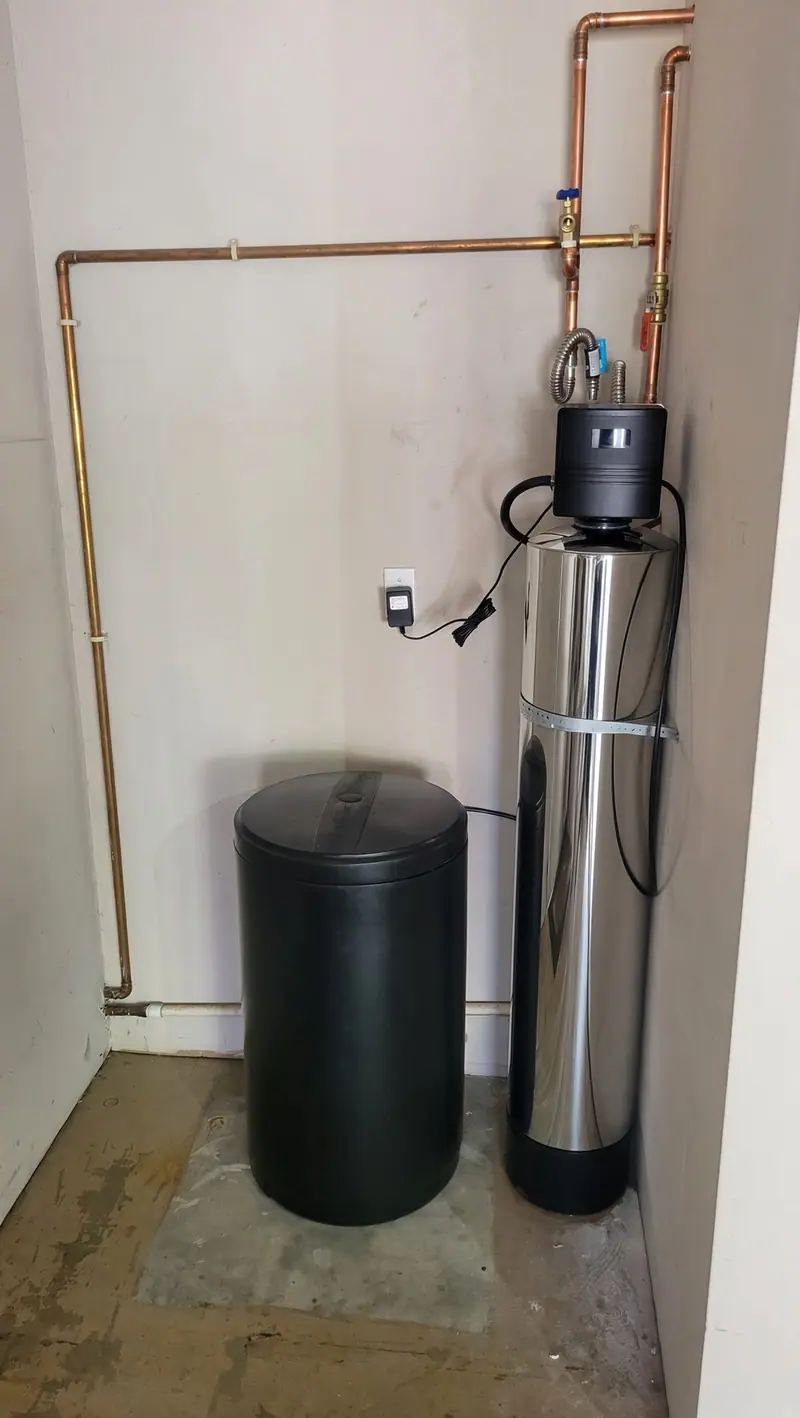
What you’ll notice
- Nearly eliminates water spottingon dishes, glasses and shower glass
- Softer-feeling skin & hairshampoo and soap rinse clean
- Soap & detergent go furtherlaundry tests used half the detergent (WQRF)
- Softer, brighter laundrytowels that don’t feel crunchy
- Water heater & fixtures last longersoftened water kept heaters at factory efficiency (WQRF)
- Less scrubbingless white crust and soap scum
Signs you need a water softener
White crust on faucets and shower heads: is that hard water?
Yes. That crust is limescale, the minerals hard water leaves behind. A softener removes those minerals, so the crust stops building up and cleaning gets a lot easier.
Why do my dishes and glasses come out spotty?
Minerals in hard water dry on the glass. A softener nearly eliminates water spotting on dishes, glasses and shower doors.
Is hard water why my shower head is clogged?
Usually. Scale closes up the spray holes and faucet screens over time, so pressure drops. Softened water keeps them clear.
Can hard water make my skin feel dry and itchy?
Many people notice it. Hard water can leave soap residue on skin and hair, and the chlorine in city water can dry them out too. Softened water rinses clean, so skin and hair feel softer; a whole-house carbon filter reduces chlorine.
Moved here from the Bay Area? Why does the water feel different?
Many people do. San Francisco’s water averaged 62 ppm (parts per million) of hardness in 2025, and EBMUD describes its water as soft to moderately hard [SFPUC 2025 Annual Water Quality Report] [EBMUD water quality FAQs]. Valley tap water is often harder, and the chlorine or chloramine used to disinfect city water can dry out skin and hair too. A softener is the fix for the hardness.
Why is there soap scum everywhere?
Hard water reacts with soap and leaves a film on tubs, tile and shower glass. Softened water means less scum, less scrubbing and soap that goes further.
Is hard water wearing out my water heater?
It can. Scale builds up inside the tank and on heating elements, which is often what makes a water heater pop and lose efficiency. Heaters on softened water kept their factory efficiency in testing [WQRF hardness research].
Hard water is the most common water problem we see from Stockton to Turlock. It shows up as white scale on faucets and shower glass, spots on dishes, stiff laundry, soap that won't lather, and water heaters that wear out early. A water softener system removes the calcium and magnesium that cause it, so every tap in your home gets soft water. Liquid Solutions Inc has installed and serviced water softeners in Manteca, Stockton, Patterson, Lathrop, Hughson, Ripon, Turlock and Modesto for 30+ years. We're family-owned since 1996 and a licensed C55 water conditioning contractor (C55 is California's water conditioning contractor license; CSLB #811243). Every job starts with a free in-home water test, so your softener is sized to your water, not a guess.
 Fleck valves from Pentair Water Solutions · Authorized Pentair True Blue dealer
Looking for water softener installation near me? We install and service softeners across Manteca, Lathrop and Patterson, plus Stockton, Ripon, Turlock and the rest of the Valley.
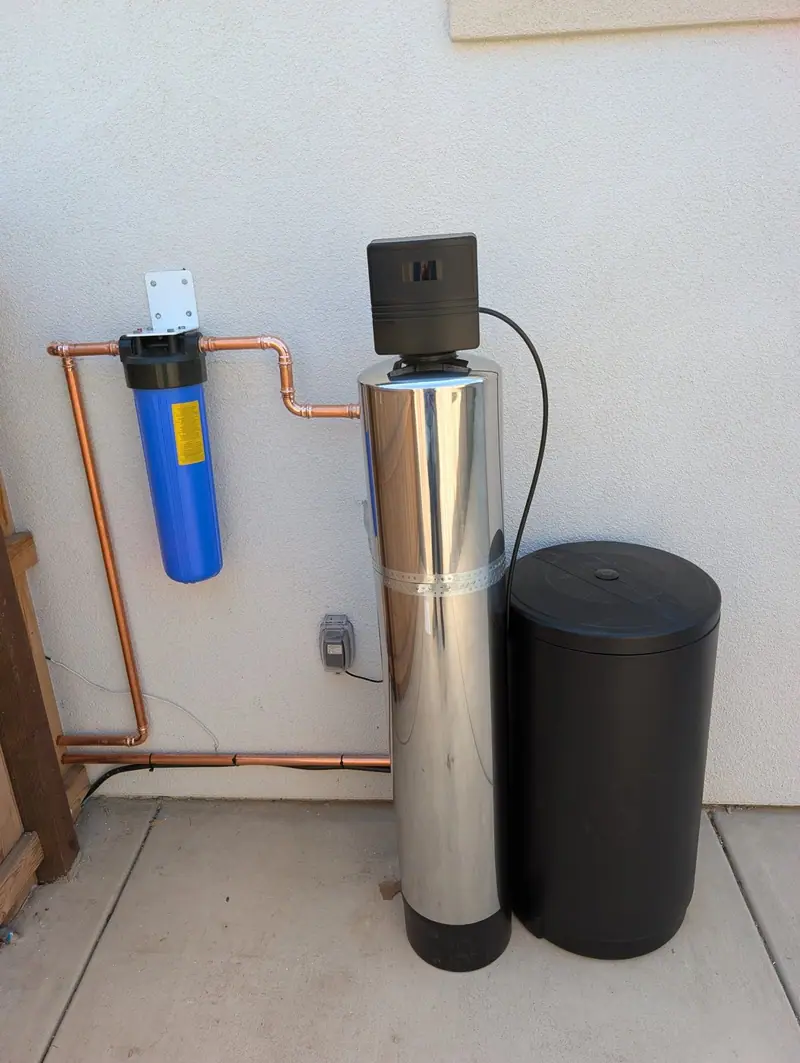
How a water softener works
A water softener runs your home's water through a tank of resin beads, controlled by a Pentair/Fleck control valve on the systems we build. The beads trap hardness minerals (calcium and magnesium) and release a small amount of sodium in their place. When the beads are full, the system regenerates: it rinses them with salt water from the brine tank and flushes the minerals down the drain. Then it's ready again. The result is soft water at every faucet, shower, and appliance, including your water heater, dishwasher, and washing machine.
Signs you need a water softener
- White, chalky scale on faucets, showerheads, and glass doors
- Spots on dishes and glasses after the dishwasher
- Dry skin and hair, and soap or shampoo that won't lather
- Laundry that feels stiff or looks dull
- A water heater that's noisy or losing efficiency
- Short life from coffee makers, kettles, and other water appliances
These are general signs, not a diagnosis. Other issues can cause similar symptoms, so we highly recommend a professional water test from our team before choosing a system. Call (209) 645-1151 to schedule.
Hard water in our area
Hardness changes from city to city, and sometimes from street to street, because many Central Valley cities blend well water with surface water.
- Patterson: city water is very hard (402 ppm on average in the city’s 2025 report). Most homes there benefit from a softener. Patterson water
- Stockton: district reports show a wide range, from fairly soft pockets to very hard water, so testing your address matters. Stockton water
- Manteca, Ripon, Turlock and Modesto: groundwater-fed systems commonly leave scale and spotting. Manteca Ripon Turlock Modesto
- Lathrop: homes east of I-5 can use a traditional softener. River Islands and other areas west of I-5 fall under Lathrop Municipal Code Chapter 13.05, which restricts new salt-based softeners, so for whole-home water we install a backwashing saltless system there (RO for drinking water is fine). Lathrop River Islands
Sizing starts with a free water test
A softener that's too small runs out of soft water and regenerates constantly. One that's too big wastes salt and water. Our free in-home water test includes hardness, precipitation, chlorine and soap testing, and more. We use those results, your household size, and your plumbing to choose the right capacity and settings. You get a written, no-pressure estimate. About our free water test
Water softener or salt-free system: we install both
Some homeowners want truly soft water. Others prefer to skip salt bags and brine entirely. We install both side by side and explain the trade-offs honestly. A traditional softener removes hardness for that true soft-water feel. A salt-free water conditioner greatly reduces scale buildup with no salt bags, no brine and no added sodium, and our saltless installs include carbon filtration for better-tasting water at every tap. It's a favorite with homeowners who want hard water protection without the upkeep.
Installation and repair
- New installs: we plumb in the softener, the bypass valve, and the drain line, set it up for your water, and show you how it works.
- Repair and service: resin, valve, and brine tank problems; softeners that stopped regenerating; salt bridges.
- Ongoing service: year-to-year service, or a service plan with service discounts and extended labor warranties.
Built-in filtration: what most softeners leave out
Most traditional water softeners only remove hardness. They don't filter anything. That means chlorine, chloramine (chlorine combined with ammonia) and sediment still flow through to your family. Those same contaminants also wear down the softener's resin (the media that does the softening) over time, which can shorten its life.
Our AquaShield Soft 5-stage system is different. It softens and filters:
- Stage 1, KDF copper-zinc media: reduces chlorine taste and odor and helps protect the media from microbial growth.
- Stage 2, high-capacity 10% crosslinked resin: commercial-grade softening resin that's more efficient than standard resin and lasts up to 50% longer.
- Stage 3, Filter-Ag sediment filtration: filters down to 20 microns, catching particles you can't see.
- Stage 4, catalytic and coconut-shell carbon: reduces chlorine, chloramines, pesticides, and other chemicals.
- Stage 5, silica base media: polishes water to sparkling clarity with strong flow.
Because the filtration protects the softening resin, your system is built to last, and your family gets soft, cleaner, better-tasting water at every tap.
For the best drinking and cooking water, add an under-sink reverse osmosis (RO) system. On a private well, iron, manganese or sulfur may need their own treatment first. See well water treatment.
Hard water and your hair
Hard water leaves calcium and magnesium on hair the same way it leaves white crust on a faucet. The most common things people tell us: hair that feels frizzy, dull or straw-like, shampoo that won’t lather, and color that seems to fade faster. Softened water lets shampoo and conditioner lather and rinse clean, so many people find their hair feels softer and shinier after the switch.
Some people notice less hair in the shower drain after moving to soft water. We can’t promise that, and hard water isn’t a proven cause of hair loss. If you’re losing hair, talk with your doctor. What a softener does do is take the mineral film out of the picture.
Just moved from the Bay Area? San Francisco’s water is soft (it averaged 62 ppm in 2025 [SFPUC 2025 Annual Water Quality Report]), and Valley water is often two to six times harder, so the change can be noticeable in your first few weeks.
Softener not working? Check these first
Spots are back, soap stopped lathering, or the water feels hard again? Most of the time it’s one of these, and several you can check yourself in five minutes:
- Salt level. Lift the brine tank lid. If you can see water above the salt, or no salt at all, add extra coarse salt.
- Salt bridge. A hard crust can form across the tank with an empty space under it. Push gently on the salt with a broom handle; if it gives way, that was the problem.
- Bypass valve. Make sure the bypass handles are in the “service” position, not “bypass.” It’s easy to bump during plumbing or garage work. See our FAQs for photos.
- Power and clock. After a power outage some valves lose the time, so they regenerate in the middle of the day or not at all. Check the display.
- More people, more water. New family members or guests can use up the softener’s capacity between regenerations. The settings may need adjusting.
- Old or worn resin, or a clogged injector. These need a service visit. Resin wears out faster when chlorine isn’t filtered first.
Still not right? Call (209) 523-5921. We service and repair existing Pentair and Fleck systems, including ones we didn’t install. If you’re searching for “water softener repair near me” anywhere from Manteca and Lathrop to Patterson, Stockton, Ripon and Turlock, that’s us.
What a water softener saves you
Hard water scale costs money inside your water heater and appliances. Here’s what independent research found:
- Water heaters: in a 2009 study commissioned by the Water Quality Research Foundation and conducted by the Battelle Memorial Institute, water heaters on softened water kept their original factory efficiency rating for as long as 15 years, while running hard water through the units cut efficiency by up to 48 percent [Water Quality Research Foundation: Water hardness (2009 Battelle study)].
- Showerheads and faucets: showerheads on hard water lost 75 percent of their flow rate in less than 18 months, and faucet strainers clogged within 19 days [Water Quality Research Foundation: Water hardness (2009 Battelle study)].
- Dishwashers and washers: after 30 days and 240 cycles, the softened-water units were nearly free of scale, while the hard-water units needed scale removal to work well [Water Quality Research Foundation: Water hardness (2009 Battelle study)].
- Detergent: softened water let testers cut laundry detergent by 50% and wash at 60°F instead of 100°F with the same or better stain removal [WQRF laundry detergent study, executive summary], and dishwashing tests found detergent savings of up to 70% [WQRF softened water benefits findings (dishwashing)].
Example estimate (gas water heater). EIA’s 2020 residential survey puts the average California household that heats water with natural gas at $273 a year for that use [EIA RECS 2020, Table CE4.16.NG.ST (natural gas water heating by state)]. Battelle estimated life-cycle energy cost savings for gas storage water heaters on softened water of 6.6% at about 170 ppm of hardness and 14.5% at about 340 ppm [WQRF/Battelle 2009 softened water benefits study, executive summary]. So: $273 × 6.6% ≈ $18 a year for hard water (about 170 ppm), and $273 × 14.5% ≈ $40 a year for very hard water (about 340 ppm). This is an estimate based on averages, not a guarantee. It covers water-heating energy only, not appliance life, detergent or repairs, and your results will vary.
Water softener FAQs
How much does a water softener cost?
It depends on your water hardness, your home's size and water use, and the system you choose. We give you a written, no-pressure estimate after a free in-home water test. Call (209) 523-5921 to schedule.
What's the difference between a water softener and a water conditioner?
A water softener removes hardness minerals using salt and resin. A salt-free water conditioner (also called a saltless water conditioner) keeps the minerals but changes them so much less sticks as scale. We install both and help you choose.
Does a water softener remove chlorine?
A traditional softener doesn't. It only removes hardness. Our AquaShield Soft 5-stage system is built with this in mind: KDF and catalytic and coconut-shell carbon stages reduce chlorine and chloramine taste and smell at every tap, and they protect the softening resin so it lasts longer.
What warranty comes with a water softener?
Our systems come with a lifetime limited tank warranty. Service plans add extended labor warranties.
Do you offer financing?
Yes. Financing is available, including 0% for 21 months on approved credit (OAC). See terms (opens in a new tab) Financing
How long does a water softener last?
Softening and conditioning systems typically last 15–20 years with regular service.
Will you need to change my plumbing?
We find a spot where we can tap into your main water line so the whole home gets softened water. We plan the location with you during the free water test.
Do I need to be home for the install?
Yes. You or a family member needs to be home to let us in.
Will soft water feel slippery?
Soft water rinses soap off differently, so some people notice a smooth feel at first. That's the soap rinsing cleanly instead of reacting with hardness minerals.
Can I have a salt softener in River Islands?
Lathrop Municipal Code Chapter 13.05 restricts new self-regenerating salt-based softeners west of I-5, including River Islands. In River Islands we install only a backwashing saltless system, which reduces scale buildup (it doesn't soften). RO for drinking water is fine there. Most of Lathrop east of I-5 can still use a traditional softener.
Free Water Test + Water Softener Estimate. Call (209) 523-5921 (office / scheduling) or (209) 645-1151 (sales). Licensed C55 contractor · CSLB #811243 · 30+ years · Family-owned since 1996.
Built to last: hand-built in the USA with NSF-certified components and Pentair/Fleck control valves. Our systems come with a lifetime limited tank warranty. Financing available, including 0% for 21 months on approved credit (OAC). See terms (opens in a new tab) Service: year-to-year service, or a service plan with service discounts and extended labor warranties.
Our Promise: we test before and after installing and adjust free until your results match · the same family-owned team from test to service · free test, written estimate, no "today only" pricing.
NSF certification applies to individual components, not the complete system.
Compare our core systems
Free water test / estimate
We reply during business hours (Mon–Fri, 9 AM–4 PM). Prefer to talk? Call (209) 523-5921.
Why book with us
- Licensed
- Bonded
- Workers' comp
- Liability
- Family-owned since 1996
- CSLB #811243
Office: (209) 523-5921
Sales: (209) 645-1151
Text: (209) 821-4777
Free Water Test + No-Pressure Estimate
Call (209) 523-5921 (office / scheduling) or (209) 645-1151 (sales), text (209) 821-4777, or message us online.
Contact Liquid Solutions Inc ★ Leave Us a ReviewWarranty note: Coverage varies by system. Certain specialty systems, such as those treating arsenic, nitrates, uranium or highly aggressive water, carry installation-specific warranties. Ask us for details.