
Water Softener & RO FAQs + Troubleshooting
Answers for your water softener, saltless conditioner and reverse osmosis system, plus buying questions and emergency shut-off steps
Licensed · Bonded · Workers' comp · Liability · 30+ years · Family-owned since 1996 · CSLB #811243
Jump to your system:
Water Softener FAQs
How do I take care of my water softener?
Keep salt in the brine tank at all times. Your system is automatic: it tracks how much water you use and only regenerates when it needs to, so it won't waste salt while you're away. Extra coarse salt works best. See "Do I need to add salt? Which kind?" below.
What is a regeneration cycle on a water softener?
Your system typically regenerates around 2:00 a.m., when you're not using water. During that cycle it flushes and refreshes itself. You may hear flowing water, and a timer on the display may count down for up to two hours. The sound can be surprising, but it's normal.
How often will my water softener regenerate?
Your softener tracks how much water you use and regenerates only when it needs to. Most family homes regenerate about once a week, and smaller households about every two weeks. It's normally set to run around 2:00 a.m., and your technician can adjust the timing.
Do I need to add salt? Which kind?
Yes. Keep salt in the brine tank, and use extra coarse salt. Most families use about 1-2 bags a month. We recommend against pellet or block salt, which can clump into a hard shelf and clog the system.
Can I use water while my softener regenerates?
Yes. Water keeps flowing to the house during the cycle; it just isn’t softened for that short time. That’s one reason we set it for around 2:00 a.m., so it doesn’t run during showers or laundry.
How do I know my water softener is working?
If it’s regularly using salt, it’s running. You’ll also notice the smooth, soft-water feel in the shower compared with the water from an outdoor hose bib.
Where can I buy water softener salt?
Softener salt is easy to find at Home Depot, Lowe’s, Ace and other major hardware and grocery stores. We can also provide salt to existing customers on request.
Do you service older Pentair, Fleck or Pelican systems?
Yes. We fully repair and service existing Pentair, Fleck and Pelican systems. For other brands, we can still do limited annual service. If you're ready for something new, we can talk about replacing it with a system we build to order. Call the office at (209) 523-5921 to schedule service, or (209) 645-1151 to talk about a new system.
Should I protect an outdoor water softener?
Yes. Cover or shelter an outdoor softener from heat and cold to protect the circuit board and help it last longer.
My water softener won't regenerate. How can I tell if it's running?
Most people never hear their system run. That's because we normally set it to regenerate around 2:00 a.m., so it never runs while you need water during the day. If your system is regularly using salt, it's definitely been running. If the salt hasn't gone down, check whether it has turned extremely hard, like a rock. If it has, the salt may be "bridged," which keeps it from dissolving. Adding a few gallons of water with a hose or bucket can help break it down. Just be careful not to fill the salt tank more than halfway with water. If that doesn't do it, give us a call at (209) 523-5921 and we'll take a look.
Should I add water to my brine tank?
No. Your system fills the brine tank on its own and only needs a little water, usually no more than a quarter full. That's by design. Adding extra water thins out the brine, so the system can't soften properly, and it wastes salt. The one exception is breaking up rock-hard salt, as described above, and even then, never fill it more than halfway.
Why is there so much water in my brine tank?
A little water in the salt tank is normal, usually no more than a quarter full. If the tank has almost no salt in it but the water is about three-quarters of the way up, that's not normal. Hold off on adding salt and give us a call. We'll come out and set it right.
Why isn't the salt level going down?
If your salt seems stuck at the same level, see "My water softener won't regenerate. How can I tell if it's running?" above for how to break up hard, rock-like salt. If that doesn't help, a quick calibration visit will get it using salt the way it should.
Why did my water pressure drop?
In water softening systems, chlorine can wear down the media inside over time, and as it breaks down, your water pressure can slowly drop. In the meantime, you can put your system in bypass to get full pressure back. See "Water softener or saltless system leak: how to put it in bypass" in the Emergency FAQs below. Then give us a call at (209) 523-5921 and we'll get it running right again.
My water doesn't feel soft anymore. Why does it feel hard again?
First, check that there's salt in the tank and that the system has power, since it may just be empty or unplugged. If there's salt and power and your water still feels hard, give us a call at (209) 523-5921. A quick calibration visit re-tests your water and sets the system to match your home.
Why does my water taste salty?
In most cases, softened water won't taste salty. If yours suddenly does, it usually means the system was interrupted mid-cycle, often by a power outage. We recommend a service call. Give us a call at (209) 523-5921 and we'll get it set right.
My softener keeps running or is leaking. What should I do?
If it sounds like it's running nonstop, look at the display on the front. If you see a timer counting down, for example from 10 minutes, the system is in the middle of a cycle. This is how it fully refreshes itself, and it can take up to 2 hours. It normally happens around 2:00 a.m., so if you hear it late at night, that's normal, even though the sound can be alarming. If it's running during the day, the clock may have been reset, often by a power outage. Give us a call at (209) 523-5921 and we'll get it back on schedule. If you see water leaking, put the system in bypass (see "Water softener or saltless system leak: how to put it in bypass" in the Emergency FAQs below) and call our emergency line at (209) 645-1151.
Why is my water black or brown?
This is almost certainly harmless. Our systems include carbon, made from coconut shells, that helps filter out chlorine, chloramine (chlorine combined with ammonia) and other unpleasant contaminants. Over time, that carbon begins to break down, and when it does, its dark color can show up in your water. Common signs are dark water or dark residue in your toilets, sinks or the fixtures closest to the softener. Think of it as a built-in signal that the system is ready to be rebuilt so it keeps working at its best. Run your faucets until the water runs clear again, then call the office at (209) 523-5921 so we can schedule a diagnostic visit.
Saltless Conditioner FAQs
How long is the cycle on a saltless system?
About 20 minutes. It's normally set to run around 2:00 a.m.
How often does my saltless system run its cycle?
Usually once a week. It runs on a one-week timer, normally set for around 2:00 a.m.
Does my saltless system need salt or regular maintenance?
No salt needed. Saltless systems are low maintenance, but the media and any pre-filter don't last forever. We recommend an annual service visit to keep it protecting your home. Call the office at (209) 523-5921 to get on the schedule.
I still see some spots. Is my saltless system working?
Yes. A saltless system reduces scale buildup, but the minerals stay in the water, so you may still see some light spots that wipe off easily.
Why is the water from my saltless system black or brown?
Most saltless systems include carbon, made from coconut shells, that helps filter out chlorine, chloramine and other unpleasant contaminants. Over time, that carbon breaks down, and its dark color can show up in your water. Common signs are dark water or residue in your toilets, sinks or the fixtures closest to the system. This is almost certainly harmless, and it's a sign the system is ready to be rebuilt. Run your faucets until the water runs clear, then call the office at (209) 523-5921 to schedule a diagnostic visit.
Why did my water pressure drop with my saltless system?
Over time, the media or pre-filter in a saltless system can wear down or clog, which slowly lowers your water pressure. In the meantime, you can put the system in bypass to get full pressure back (see the Emergency FAQs below). Then call us at (209) 523-5921.
My saltless system is leaking. What should I do?
Put the system in bypass. See "Water softener or saltless system leak: how to put it in bypass" in our Emergency FAQs. For an urgent leak, call our emergency line at (209) 645-1151. To schedule service, call the office at (209) 523-5921.
Can I still buy a Pelican water system?
Pelican systems are no longer made, but you can still have one just like it. We build an equivalent or better system to order, and we still service existing Pelican units. To schedule service, call the office at (209) 523-5921. To talk about a new system, call (209) 645-1151 or see our Pelican Water Systems page.
Should I protect an outdoor saltless system?
Yes. Cover or shelter an outdoor saltless system from heat and cold to help it last longer.
Reverse Osmosis FAQs
Why is my reverse osmosis faucet running so slowly?
A slow faucet can have a few different causes, such as a clogged filter, a storage tank that isn't holding pressure, or low water pressure coming into the sink. Since it can be any of these, the easiest step is to give us a call at (209) 523-5921. A service visit will find the cause and get your flow back.
How often should my reverse osmosis filters be changed?
In most cases, once a year. We can set you up with annual service so you never have to think about it.
My reverse osmosis water tastes or smells off. Is that normal?
No. Your water should taste clean and fresh. An odd taste or smell usually means the filters are overdue for a change or something in the system isn't working right. Give us a call at (209) 523-5921 and we'll take care of it.
Why do I hear water running or gurgling under my sink?
Your reverse osmosis system has a small drain line that carries away what it removes from your water during purification. Because of the shape of the sink and drain, that flow can sound like a lot more water than it really is. In reality, it's roughly a one-to-one exchange: for about every gallon of purified water it makes, it sends about a gallon to the drain. Depending on the shape of your sink's drain pipe and where the drain line had to be installed, you may hear it the whole time the system refills, which is roughly an hour. That's normal. If the sound bothers you, ask your technician about possibly moving the line, or put the stopper in your sink drain to quiet it. If it never seems to stop, give us a call at (209) 523-5921 and we'll take a look.
My reverse osmosis system is leaking. What should I do?
Shut off the water to the system. See "Reverse osmosis leak: how to turn off the water" in the Emergency FAQs below. For an urgent leak, call our emergency line at (209) 645-1151. For a service appointment, call the office at (209) 523-5921.
How much water does the reverse osmosis tank hold?
About 1 to 1½ gallons of usable water. The tank itself is larger, because air and the bladder take up space. From empty, it takes roughly an hour to refill.
What is a reverse osmosis membrane?
The membrane is the special filter that makes reverse osmosis work. After the water passes through the other filters, it’s pushed through the membrane. Water small enough to pass goes to your storage tank, and the rest goes down the drain. Membranes aren’t changed every year like the other filters.
Why is my new reverse osmosis water a little cloudy?
That’s common. Cloudiness and tiny bubbles come from the purification process (a little oxygen) and a new storage tank stretching its bladder. It usually clears in two or three weeks. Call the office at (209) 523-5921 if it lasts longer.
Buying FAQs
Emergency FAQs
If your system is leaking, the steps below will help you stop the water safely. To schedule service, please call our office at (209) 523-5921, Monday through Friday. Scheduling is handled only through the office. If you're in a pinch outside office hours, our emergency line, (209) 645-1151, is available seven days a week to help you get things under control until our office team is back. Our service team is out Tuesday through Saturday.
Reverse osmosis leak: how to turn off the water
First, find where the water is coming from. Before you do anything else, check whether the leak is actually coming from the reverse osmosis system. The steps below only stop leaks from the system itself. They won't stop a leak from other plumbing under the sink, like the drain pipes or the faucet. If the water is coming from your sink's plumbing instead, shut off the water valves under the sink and call your plumber.
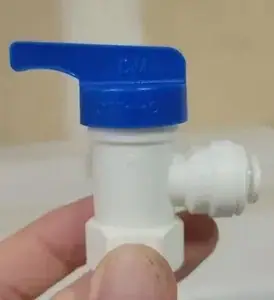
Your reverse osmosis system is under the kitchen sink. To stop a leak, close two valves, then release the pressure. Newer valves are white with blue handles. Older ones may be chrome or brass and look a little different from the photos.
- Close the valve on top of the storage tank. The storage tank looks like a small propane tank. It's usually white and sits under the sink next to the filters. The valve is on top, where the tubing connects, and usually has a blue handle. The tubing connected to it is often a bright color, like blue or yellow. Give the handle a quarter turn. Which way it turns depends on how the tank is sitting, so turn it gently and feel for the direction it gives. Don't force it. When it's closed, the handle points across the tubing instead of along it.
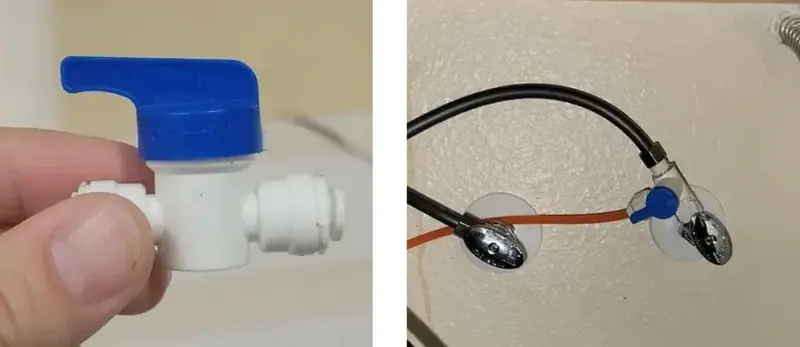
- Close the supply valve. Follow the small tube, usually orange, from the system to the valve on your cold water line under the sink. It may be up high, just under the faucet. Give it a quarter turn the same way. If you can't find a separate valve, turn off the cold water valve under the sink instead.
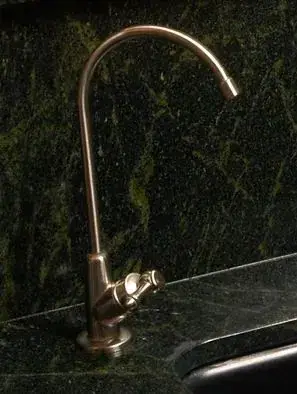
- Release the pressure. Turn on your drinking water faucet (the small separate faucet at your sink) for about three seconds, then turn it off.
- Dry the area. A little dripping for 10 to 15 minutes is normal while the pressure drains. Wipe up the water and point a fan into the open cabinet to keep the cabinet floor from swelling.
- Call us. To schedule service, call the office at (209) 523-5921. Need help right now? Call our emergency line at (209) 645-1151, any day of the week.
Reverse osmosis leak detector is beeping
New reverse osmosis installs come with a free leak detector. It beeps and shuts off water to the system when it senses moisture.
- Reset it. Pick up the blue and white box, dry the two metal bars on the bottom, then hold the blue Check/Reset button until you hear a long beep. Water to the system turns back on.
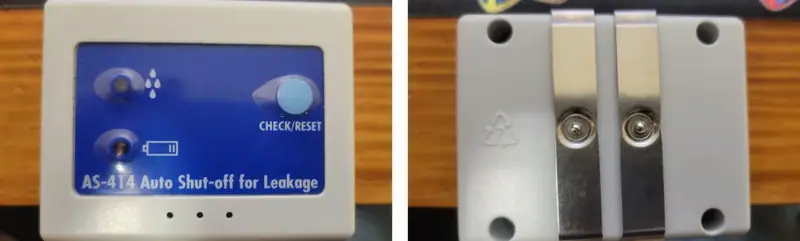
- Find the source. If the leak is from the reverse osmosis system, shut it off using the steps above and call us. If it's from the garbage disposal or another part of the sink, call your plumber, and set the detector upside down (metal bars up) until it's fixed so it stops beeping.
- Still beeping? Pull the battery. If the detector is too wet to reset and won't stop beeping, take the battery out. It's a 9-volt battery, like the one in a smoke detector, behind a small door on the side edge of the box, just like a remote control. Slide the door open and gently pull the battery off the contact points. Once the leak has been dealt with and the detector is dry, put the battery back in and reset it. Your reverse osmosis system won't make water again until you do.
Water softener or saltless system leak: how to put it in bypass
Bypass sends water around your system, which stops the leak and keeps water flowing to your home until we arrive. Your system is outside, in the garage, or wherever it was installed. The bypass is where the pipes connect at the back of the valve on top of the tank. It comes in three styles:
- Two blue handles: Turn both a quarter turn in the direction of the small arrows, so they point across the pipes.
- Two black knobs: Put a small screwdriver in the holes for leverage and turn both a quarter turn in the direction of the arrows.
- One red handle: Turn it toward the side marked bypass.
Don't force it. If it keeps dripping for a bit, give the pressure time to drain. On systems over 20 years old, use the bypass only if you really need to, since older valves can break. If you can't get it to work, shut off your home's main water valve. That stops the leak, though it also turns off water to the house. Then to schedule service, call the office at (209) 523-5921. Need help right now? Call our emergency line at (209) 645-1151, any day of the week.
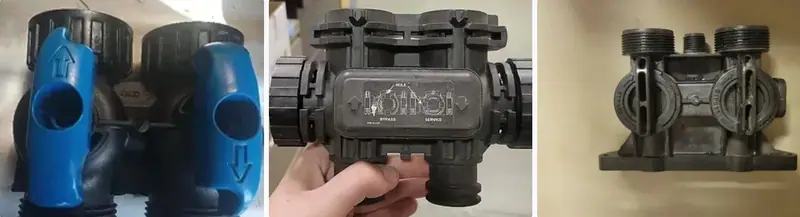
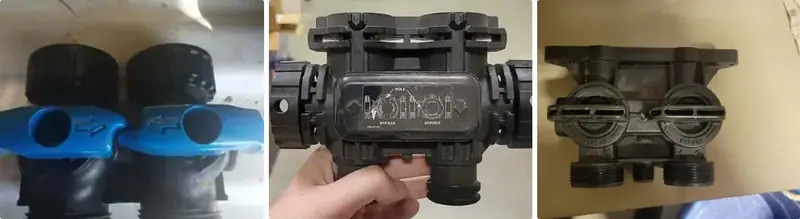
Older installs may use the two-blue-handle style on the left. Some newer installs use it too, since the industry has started using that style again.
Free Water Test + No-Pressure Estimate
Call (209) 523-5921 (office / scheduling) or (209) 645-1151 (sales), text (209) 821-4777, or message us online.
Contact Liquid Solutions Inc ★ Leave Us a Review